Wednesday, 29 September 2010

Firewood


If you start to manage a woodland it almost certainly means that some of the trees will have to be felled. It makes sense to remove the trees that are poorly shaped or overcrowded to give more space to the trees that are of better form and have the potential to grow into quality timber. Therefore you need to do something with the wood from the trees that have been felled and firewood is an obvious solution.
I always fell the trees after the leaves have fallen during the winter months. This way it causes less disturbance to the wildlife especially nesting birds. It is also too hot here during the summer months for chainsaw work. I find that even in winter within a few minutes of starting to cut I am down to my T-shirt. So I stop felling in early April and then spend 3-4 weeks bringing all the wood that has by now been cut into 1 meter lengths out of the forest and to a clear open area where the logs will later be split and stacked. It is essential that this is a sunny spot where the breeze can blow through to dry the wood. If the split wood is not stacked in the sun their is no chance that it will be dry enough for it to be burnt the following winter.

For the last 10 or so years I have split all my wood by hand using a combination of steel wedges and a 2.5kg log splitting axe. I could generally split about 1 cubic meter of wood per hour this way. If it was knotty oak it wood take a little longer or if it was nice straight sweet chestnut it could be done in as little as half an hour. I found that a session of up to 2 hours was about right for me and I split about 130 cubic meters in total during April and May of each year. Splitting this volume of wood by hand however did lead to the development of very painfull tendonitis in both elbows and forearms. It had got to the point where I had to mechanise the wood splitting or cease production.

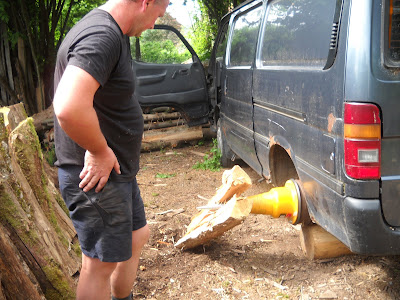
Not having much cash for investment I looked around for something a little different to the usual log splitting equipment. On Ebay I found a rotary wood splitter called The Stickler (www.the stickler.com)which is bolted by means of an adaptor plate onto the back hub of almost any rear wheel drive vehicle. It costs around $279 and $130 delivery to France, although this was discounted by $50 as they were offering free delivery in the U.S. at the time.


The Stickler in action using my battered 1993 Toyota Hiace as the muscle power


With this extremly efficiant tool I was able to split over 200 cubic meters of wood over the course of 4 weeks working 3-4 hours per day. The cost of this was around 60 litres of red diesel but I saved myself a great deal of fatigue and physical damage. With the help of a second person the wood could have been split much quicker. I lost a lot of time getting the logs to the splitter and then stacking the splits. The finishes log piles are then immediatly covered with plastic sheeting to keep the rain out. This way with our usual hot summer the wood is ready to start being delivered during August to my loyal group of customers.


Part of a finished wood pile, this one represents about a quarter of the total firewood split for this year

Wednesday, 28 July 2010

What's wrong with forestry today?


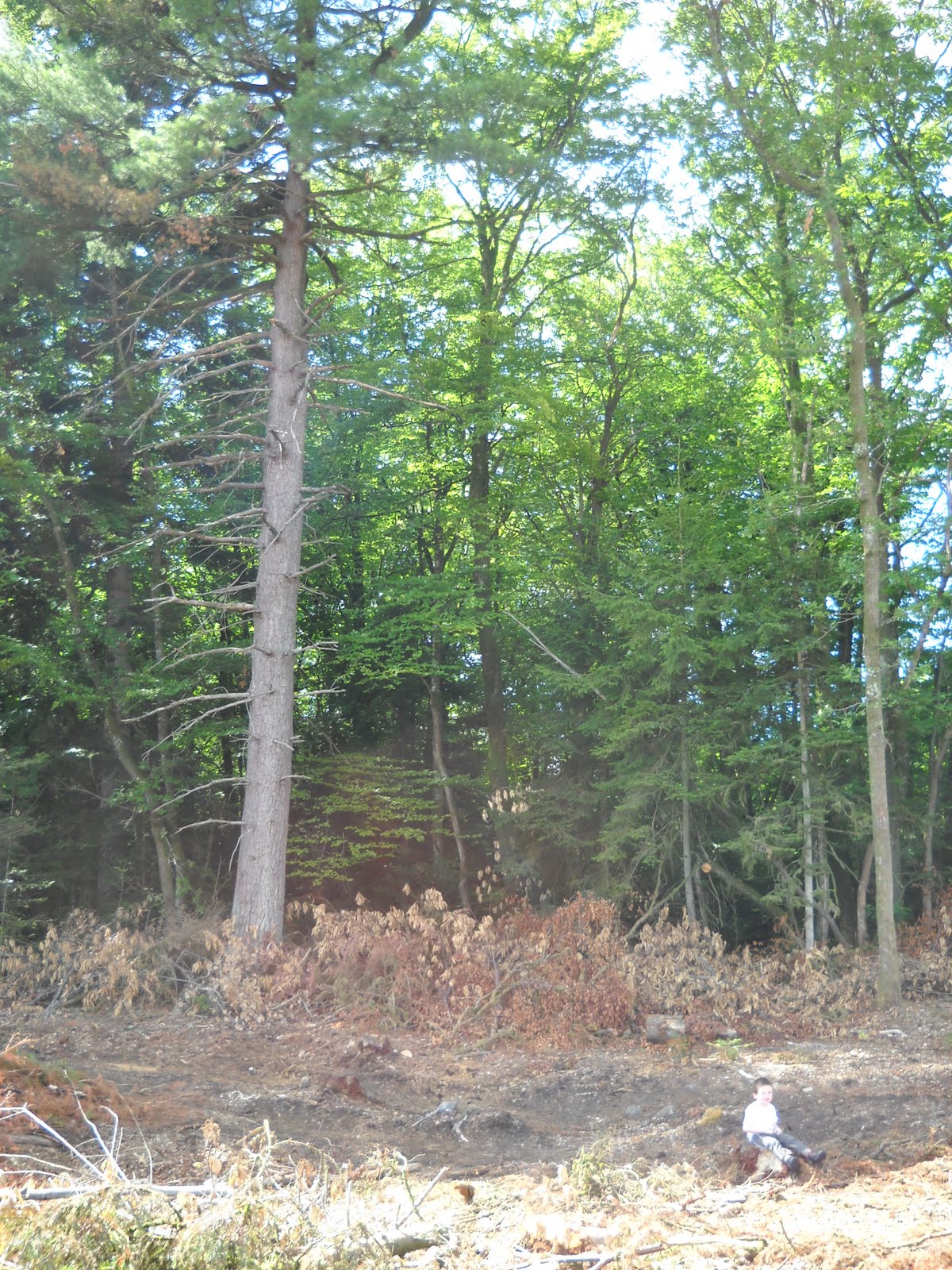
I took these photo's today, close to where I live and it is an absolutely typical example of the type of forestry that is practiced around here and in so many other places too. This piece of woodland was a very prominent landscape feature and now it has been felled it is even more eye catching to the many thousands who drive past it each day.

From counting the growth rings this wood represents over 70 years of growth since it's last clear felling. It appears to have been completely unmanaged and by consequence has grown into a low quality, low value crop with virtually all the timber being sent to the local pulp mill where it has a value of around 19 euros per ton. An entire human lifespan to produce an almost valueless product. But it didn't have to be that way. Just a little bit of periodic management to thin the overcrowded trees and remove those of poor form would have concentrated the growth potential in the remaining better trees, which could of then grown on to be of a high enough quality for saw milling and be worth 10 to 20 (or even more) times as much. Still taking the same 70 years to grow and mature.


Large areas of woodland should never be clear felled. A forest is a living entity that modifies the soil it grows in, moderates temperature extremes, reduces windspeeed, increases humidity, greatly reduces rainfall runoff and many many other additional beneficial factors as well. When it is felled, in a moment all this is lost. It becomes a micro climate of extremes. Today it was baking hot and it was as if the whole site had been sterilised. There was not a bird, beetle,bug or animal of any kind, absolutely devoid of all life. You could then step from this into the part of the woodland which still remains (for the time being). It was like walking through a door from one room to another - totally different in every way. There surely has to be a better way than this to manage our forests.


So what is the future for this wood? Well as long as it is not cleared for housing or agriculture it will eventually recover. Already some of the cut stumps were showing signs of life. The regrowth is surprisingly quick. The sweet chestnut can grow up to 3 metres in the first year here after being felled. Although this soon slows down, within about 20 years it will look like a wood again. Without management it will soon once again become overcrowded, dark and spindly and slowly as the years roll on, edge ever closer to its next brutal low value clear fell


Sunday, 25 July 2010

How it all began

This is an introduction to give you some idea as to how I came to be here doing what I am doing.
It was 1996, Life was stuck in a rut, repetitive job, long hours for not much reward. I was fed up of Britain, house prices were already out of reach and it seemed that we would be renting forever. We also had a baby on the way so life was about to change, so why not make it a big one and change everything.

So we went to a French property show in Harrogate, couldn't believe how cheap properties were in the Limousin. We could have a house and barns and lots of land with a monthly mortgage payment way less than what we were renting just a house for in Cumbria.
I only had enough spare cash to do one property finding visit. This was also my first time in France, and so I struck lucky and agreed to buy the second property I visited.
In August 1997 the mortgage was arranged and the place was ours(and the banks) It consisted of 2 houses in need of renovation, 2 large barns and 27 acres of land, mostly treed and badly neglected and
spread over 46 separate parcels. After half a dozen week long renovation visits during the following
winter we arrived here permanently in early June 1998 with all our possessions packed in a van, a 9 month old baby, virtually no money, no job and not a word of French- even to me this now looks a little foolhardy when I see it written down.

So what, I asked myself could I do to earn some money here. This is how I got started producing firewood both for ourselves and to sell. I had only once before picked up a chainsaw, I did a weekend chainsaw course run by the BTCV somewhere around Newcastle when I was 18. The course was great however at the end they showed an old Forestry Commission Video of chainsaw safety and accidents which scared me to death and resulted in me not picking up a chainsaw for another 15 years.

So I was now in the situation where economic necessity forced me to conquer my fear of self preservation and so I acquired an old, late 1970's Stihl 08 which is all metal and weighs a ton. Little by little trust was built between man and machine and a great partnership resulted. I now have a Husqvana 365 which is a beautiful machine, powerful, productive and solid but not too heavy.

So I began to make a start on my woods using a basic principle to remove the poorer and overcrowded trees to give space to the better ones so that they might realise their full growth potential. So this my first ever posting in my very first blog gives you a little background to what will unfold in the posts that will follow. Hopefully a few of you will find the adventure interesting and worth following. I refuse to believe that I am the only tree mad person out there!

Thanks for looking -Michael